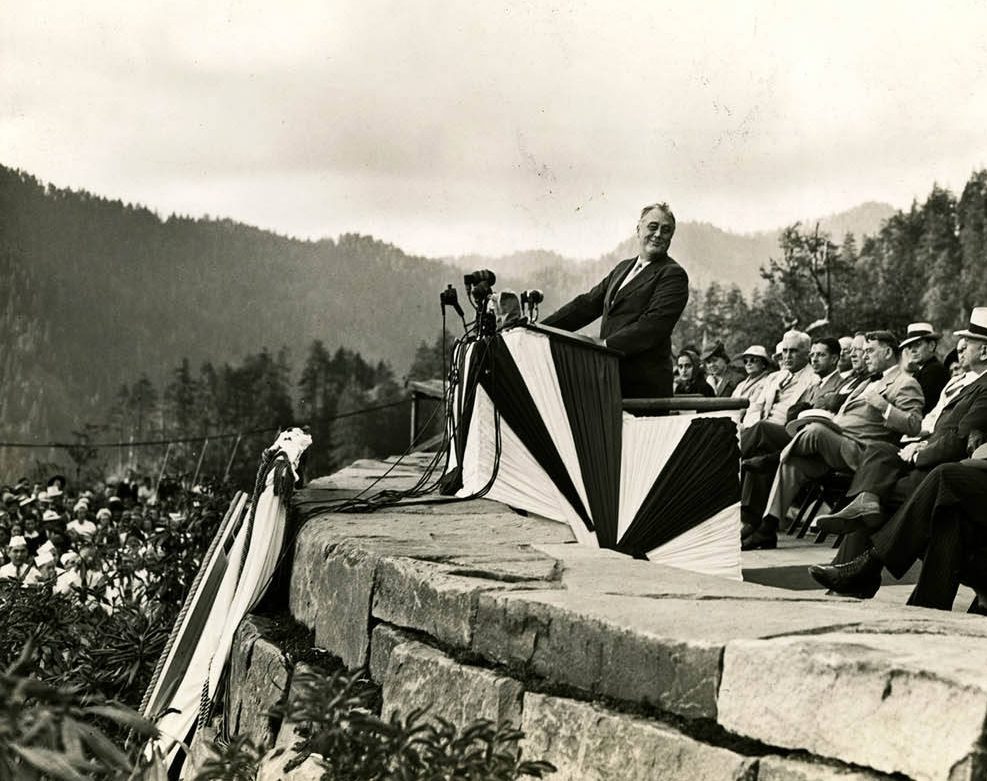
(Photo Courtesy of the Tennessee State Library & Archives)
The Great Depression remains one of the most severe economic crises in American history, and economists continue to debate what caused the collapse and how the country eventually worked its way out. For decades, scholars have discussed whether the catastrophe had resulted from deep structural flaws in capitalism, severe policy mistakes, or sudden shocks to the financial system. To truly understand this period, however, it helps to examine two of the most influential frameworks that attempt to explain the boom-and-bust cycle. For this brief study, those sources would be the monetarist perspective championed by Milton Friedman and Anna Schwartz, and the Austrian business cycle theory detailed by Fred E. Foldvary. Looking at these theories alongside others, such as Christina Romer’s research on the recovery and Michael Bordo’s modern evaluations, gives us a well-rounded picture of the interwar era.
Methodology and Sources
This research argues that, in order to analyze the Great Depression properly, a study much draw on both quantitative historical data and qualitative economic analysis. Therefore, the primary research relies on extensive statistical records that track money supply, gross national product, as well as interest rates, alongside robust, scholarly historical monographs. Additionally, this paper also examines some of the foundational (and quite influential) writings by Milton Friedman and Anna Schwartz, specifically their extensive data series in A Monetary History of the United States and their study on money and business cycles. These particular measures are, in turn, paired with Foldvary’s theoretical exploration of Austrian capital structures, Romer’s empirical simulations regarding the impact of monetary expansion after 1933, and Bordo’s insights into modern economic modeling. These sources, it could be argued, complement each other nicely as they isolate different primary causes, ranging from monetary collapse to capital malinvestment, while also using the same historical timeline to test and prove their respective arguments.
Monetarist versus Austrian Interpretations
For first explanation, the basic contention of the monetarist framework is that significant changes in the growth rate of the money supply are the main driving force behind changes in income and general economic activity. From this standpoint, the Great Depression was not a simple, unavoidable failure of the free market, rather it was the tragic result of critical policy blunders by the Federal Reserve. As the crisis worsened between 1929 and 1933, the U.S. money supply dropped by more than a third because a wave of bank panics terrified the public into hoarding cash, thus also causing the banks to hoard reserves. Because the Federal Reserve failed to act as a lender of last resort, it essentially allowed an already severe financial panic to transform into a much larger, catastrophic-level economic depression. Bordo points out that while modern economic models also factor in financial frictions and net worth collapses, the core monetarist conclusion remains central: monetary contraction caused the ultimate downturn. Further building on this idea, Romer uses empirical simulations to show that the dramatic recovery of the mid and late 1930s was mainly driven by expansion rather than mere government spending. Specifically, a massive influx of gold, sparked by the government’s 1933-dollar devaluation and European capital flight, lowered interest rates and spurred investment, proving that monetary forces were the true drivers of eventual recovery.
On the other side of this contentious debate, the Austrian school of economic thought places the blame for the Great Depression directly on the artificial economic boom of the preceding 1920s. Rooted in the beliefs of thinkers like Carl Menger, Ludwig von Mises, and Friedrich Hayek, the Austrian view claims that when central banks push interest rates below their natural market values, they trigger excessive, almost always unsustainable investments in long-term capital projects and real estate. Once the monetary authority eventually pulls back to control inflation, interest rates skyrocket, and these projects are suddenly exposed as unprofitable malinvestments. The resulting economic bust, as well as correlating high unemployment rates, are seen by Austrian thinkers as a necessary economic correction to metaphorically “wash away” the distortions caused by former interference by the government. While monetarists tend to view the 1920s as a period of successful stability managed by central bankers, Austrian scholars claim that the same decade was virtually a dangerous credit illusion that made the future devastation of the 1930s fundamentally inevitable. Moreover, while monetarists call for active central bank intervention and the creation of additional money to rescue a faltering economy, Austrian theorists argue for a hands-off approach and return to a stricter commodity standard in order to prevent artificial credit booms from taking root in the first place.
Conclusion
Ultimately, it could be said that the Great Depression is best understood as a powerful collision between monetary collapse and structural economic distortion. While Friedman, Schwartz, Romer, and Bordo give thought-provoking evidence that monetary shocks and gold inflows determined the extent of the crash, as well as the speed of its following recovery, others (like Foldvary and the Austrian perspective) remind researchers and history enthusiasts alike of the hidden dangers created by artificial credit booms. Bringing these views together, and comparing their arguments, merits, and differences with one another, would conclusively suggest that maintaining a healthy economy requires careful attention to monetary stability to prevent deflationary spirals, as well as a respect for market signals that keep investments sound and sustainable.
Bibliography
Bordo, Michael D. “Comment on ‘The Great Depression and the Friedman-Schwartz Hypothesis’ by Lawrence Christiano, Roberto Motto, and Massimo Rostagno.” Journal of Money, Credit and Banking 35, no. 6 (2003): 1199–1203.
Foldvary, Fred E. “The Austrian Theory of the Business Cycle.” The American Journal of Economics and Sociology 74, no. 2 (2015): 278–297.
Friedman, Milton, and Anna J. Schwartz. “Money and Business Cycles.” The Review of Economics and Statistics 45, no. 1 (1963): 32–64.
Romer, Christina D. “What Ended the Great Depression?” The Journal of Economic History 52, no. 4 (1992): 757–784.


Leave a comment