Introduction
The American South witnessed significant economic transformations during the early twentieth-century as rural communities attempted to connect their agrarian traditions with industrial modernization. It was in the quaint valley region of rural East Tennessee that the small town of Dayton emerged in the late nineteenth-century as a bustling village of railroad expansion, coal mining, and iron manufacturing supported in large part by northern capital investments — a scene partially similar to that of an old west “Boom Town.” However, by the early decades of the 1900s, local economic ventures proved volatile with the closure of once major industrial players such as the Dayton Coal and Iron Company (DC&I). Within this stress of economic vulnerability, local merchants and civic entrepreneurs played a vital role in sustaining Dayton’s struggling economy. Among them, Frank Earle “F.E.” Robinson, widely known as the “Hustling Druggist” to Daytonians, stood at the center of the town’s business district. Operating a small, but locally significant drugstore situated along Main and Market Streets, Robinson’s business career would capture both the complex realities of small-town retail, as well as credit dependencies and the impact of local civic boosters during the first quarter of the twentieth century.
Research Methodology and Sources
To analyze the experiences of F.E. Robinson and evaluate the broader economic environment within which his business existed, this study approaches its research with a firm grounding in primary documentation and diverse academic articles. Primary sources include mercantile directories with credit ratings, commercial advertisements, historic maps, and contemporary promotional booklets. Specifically, the Mercantile Agency Reference Book of 1905 provides baseline financial strength and credit classifications for Dayton merchants, including the precursor partnership of Crawford and Robinson. Sanborn Fire Insurance Maps, available through the Library of Congress, and local archival photographs from the Tennessee State Library and Archive’s “Tennessee Virtual Archive” offer solid evidence regarding the physical layout and structural expansion of Dayton’s downtown commercial spaces.
These primary sources were also cross-referenced with important regional histories and more macroeconomic works too. As an example, Dr. Edward J. Larson’s Pulitzer Prize-winning work, Summer for the Gods: The Scopes Trial and America’s Continuing Debate Over Science and Religion, furnishes critical context regarding Dayton’s post-industrial economic stagnation and the motivations driving local business leaders to seek some form of stimulation for their dwindling economy. Local historical compilations such as the History of Rhea County, Tennessee, featuring brief contributions by well-respected Dayton historian, Dr. Richard M. Cornelius, as well as family genealogies compiled by Robinson’s son, Wallace C. “Sonny” Robinson, provide in-depth personal backgrounds and business histories regarding Robinson’s entry into business, his real estate holdings, his extensive merchant networks, and his civic leadership and educational involvement.
To satisfy the typical analytical analysis often accompanying the researching of economic conditions, this study also incorporated the insights of Gabriel Kolko’s The Triumph of Conservatism, which contended that business leaders and political leaders often used regulatory measures and state intervention in an attempt to make markets more stable and predictable, a phenomenon he designated as “political capitalism.” These frameworks are then further evaluated through Robert L. Bradley Jr. and Roger Donway’s “Reconsidering Gabriel Kolko” article, which offers an interesting perspective on property rights, business lobbying, and the distinction between market competition and state-assisted privilege. Finally, Murray N. Rothbard’s The Costs of War: America’s Pyrrhic Victories provides an excellent chapter regarding the overarching influence of the Progressive Era’s state-building, corporatism, and technocratic centralization. This interdisciplinary approach assists tremendously in bridging microeconomic retail data with macroeconomic historical critique.
Analytical Comparison: Merchant Capitalism and Economic Adaptation
Frank Earle “F.E.” Robinson was born in June 1881 in Evensville, Tennessee, to Charles R. and Ella Ann (Colville) Robinson, later moving to the nearby town of Dayton when his father relocated the family in 1886. Robinson’s early entrepreneurial training would appear to have begun at the age of fourteen, under merchant Frank McDonald, when he learned the importance behind foundational retail strategies. Always alert to any profitable opportunity, young Robinson established an innovative local laundry collection service. Transporting dirty linens via the railroad to commercial steam laundries located in places such as Chattanooga, Robinson always ensured a timely return of clean garments for his local clientele. This venture would eventually help generate vital capital, thus allowing the enterprising young men to expand his personal service network, one that soon included special orders for metropolitan newspapers and imported goods that were otherwise unavailable through traditional general stores.
By 1900, Robinson used this accumulated capital to acquire James M. Crawford’s share of a downtown Dayton drugstore operated alongside his (Crawford’s) brother, John Crawford. Realizing the importance of formal professional training, Robinson went on to attend Cumberland University, in Lebanon, Tennessee, where he completed his certification as a registered pharmacist. By March 1909, the business officially reopened as Crawford & Robinson, “the Hustling Druggists,” prominently featuring a newly installed, state-of-the-art soda fountain on the store’s prominent counter. According to the 1905 Mercantile Agency Reference Book, the firm was categorized with solid local credit, thus reflecting steady liquidity in a community that was rapidly transitioning away from its dependence on heavy industries.
As the decades progressed from the 1900s to the 1910s, Robinson’s business would eventually supersede simple prescriptions as he operated a multifaceted retail hub that drew in diverse consumers during an era of expanding packaged goods. As chronicled in local history books, Robinson capitalized on school textbook distribution, patent medicines, and high-margin soda fountain sales. Furthermore, his entrepreneurial activities extended beyond his physical storefront into real estate acquisition, downtown infrastructure support, and civic leadership. When stagnation threatened the town following the decline of local manufacturing and countywide population (which dropped from a peak of roughly 3,000 residents down to fewer than 1,800), Robinson and fellow civic boosters actively sought creative, innovative methods to stimulate Dayton’s economy.
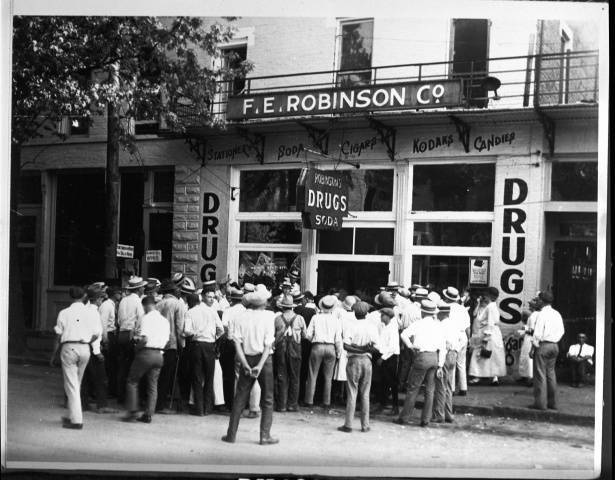
(photo courtesy of the Tennessee State Library & Archives’ Tennessee Virtual Archive)
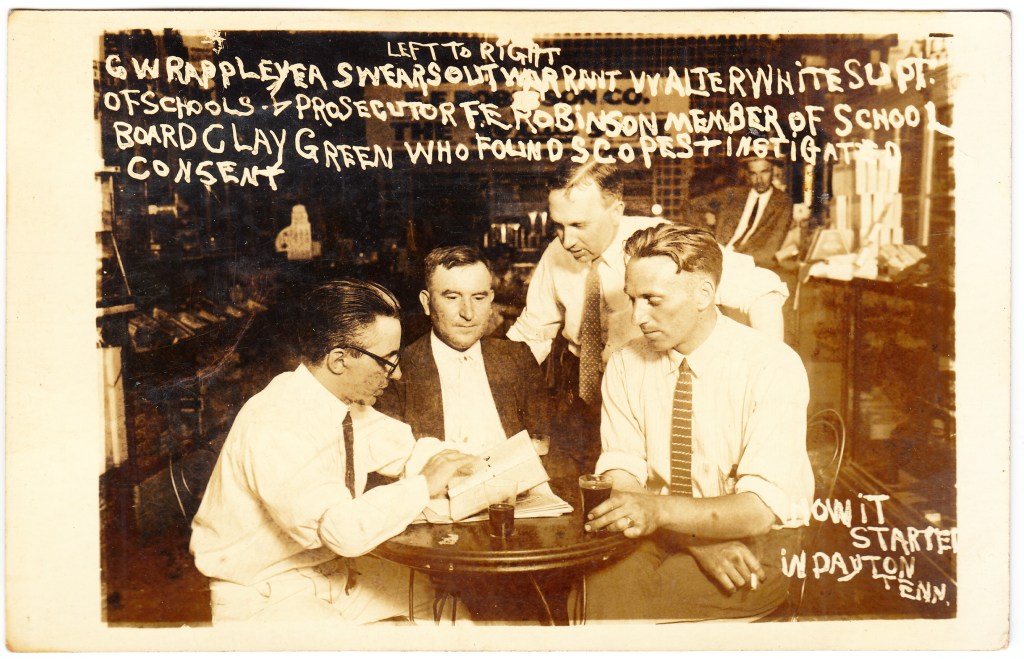
Beyond his immediate commercial operations, however, it is also necessary to mention that Robinson built and commanded the reputation of a well-respected community leader, ultimately establishing his downtown storefront as Dayton’s definitive social and professional gathering place. His drugstore functioned as the natural meeting spot for local business leaders and professional elites alike during the era of Prohibition, which assists in the explanation of how he and a diverse group of businessmen planned the world-famous Scopes Trial around a small table within his establishment. Viewed through the lens of Kolko’s historical analysis, small-town merchants like Robinson often operated under economic circumstances where stability and predictability were non-negotiable. As Bradley and Donway also proved, business strategies during this era usually reflected efforts by businessmen to secure their investments against economic shocks, whether through local boosters or institutional cooperation. This mercantile mindset coincides rather well with how Robinson, who also acted as chairman of the local school board, alongside mining engineer George W. Rappleyea and school superintendent Walter White, utilized his drugstore as a planning center to subsequently orchestrate a national publicity campaign following the trial’s instigation. While popular history regrettably reduces the “chance meeting” of the media-labeled “drugstore conspirators” to a simple gathering, primary documentation and scholarly evidence by Larson shows that local merchants viewed the event as a critical economic stunt. By leveraging national media coverage, tourism, and outside capital, Robinson and his fellow merchants sought to inject vital commerce into their depressed Appalachian market, temporarily boosting Dayton’s population to over 5,000 visitors and revitalizing local retail turnover seemingly overnight. This local mobilization, in turn, it could be argued, greatly paralleled the broader trends of the Progressive Era’s corporatist organization and managed stability as analyzed by Murray N. Rothbard.
Concluding Statement
The study of F.E. Robinson’s business career between 1900 and 1929 shows the true complexity of individual-owned business, rapid regional economic changes, and broader institutional frameworks at play in the New South. Far from a passive victim of post-industrial decline, Robinson helped actively deploy innovative retail strategies and aggressive civic boosters to sustain his both enterprise and, in truth, the community of Dayton as a whole. His drugstore served not only as the town’s premiere commercial establishment, but as an institutional anchor for the community and small-town economic survival. Furthermore, it could easily be argued that Robinson’s enduring legacy extended far beyond his retail ventures, as his involvement with the Scopes Trial subsequently led to him becoming a foundational founder, incorporator, and long-serving chairman of the Board of Trustees for William Jennings Bryan University (today Bryan College), assisting tremendously in guiding the institution through its early and most formative decades. Ultimately, integrating primary documentation with the historical critiques of Kolko, Bradley, Donway, and Rothbard show history enthusiasts how early twentieth-century merchants, particularly those in the countryside, adapted to modern consumer economies while also securing a lasting place in community leadership and development.

Source List (Turabian Bibliographic Citations)
- Bradley, Robert L., Jr., and Roger Donway. “Reconsidering Gabriel Kolko: A Half-Century Perspective.” The Independent Review 17, no. 4 (Spring 2013): 561–76.
- Cornelius, Richard M., and Wallace C. Robinson. “World’s Most Famous Court Trial” and “Frank Earle Robinson.” In History of Rhea County, Tennessee, 66–70, 353–54. Dayton, Tenn.: Rhea County Historical and Genealogical Society, 1991.
- Dun, R.G., & Co. Reference Book (The Mercantile Agency). Vol. for 1905 (State of Tennessee section, Rhea County data). New York: R.G. Dun & Co., 1905.
- Kolko, Gabriel. The Triumph of Conservatism: A Reinterpretation of American History, 1900–1916. New York: Free Press, 1963.
- Larson, Edward J. Summer for the Gods: The Scopes Trial and America’s Continuing Debate Over Science and Religion. New York: Basic Books, 1997.
- Rothbard, Murray N. “World War I as Fulfillment: Power and the Intellectuals.” In The Costs of War: America’s Pyrrhic Victories, edited by John D. Denson, 249–99. Auburn, Ala.: Ludwig von Mises Institute, 1999.
 The Past and Present with Jacob S.
Leave a comment