Introduction
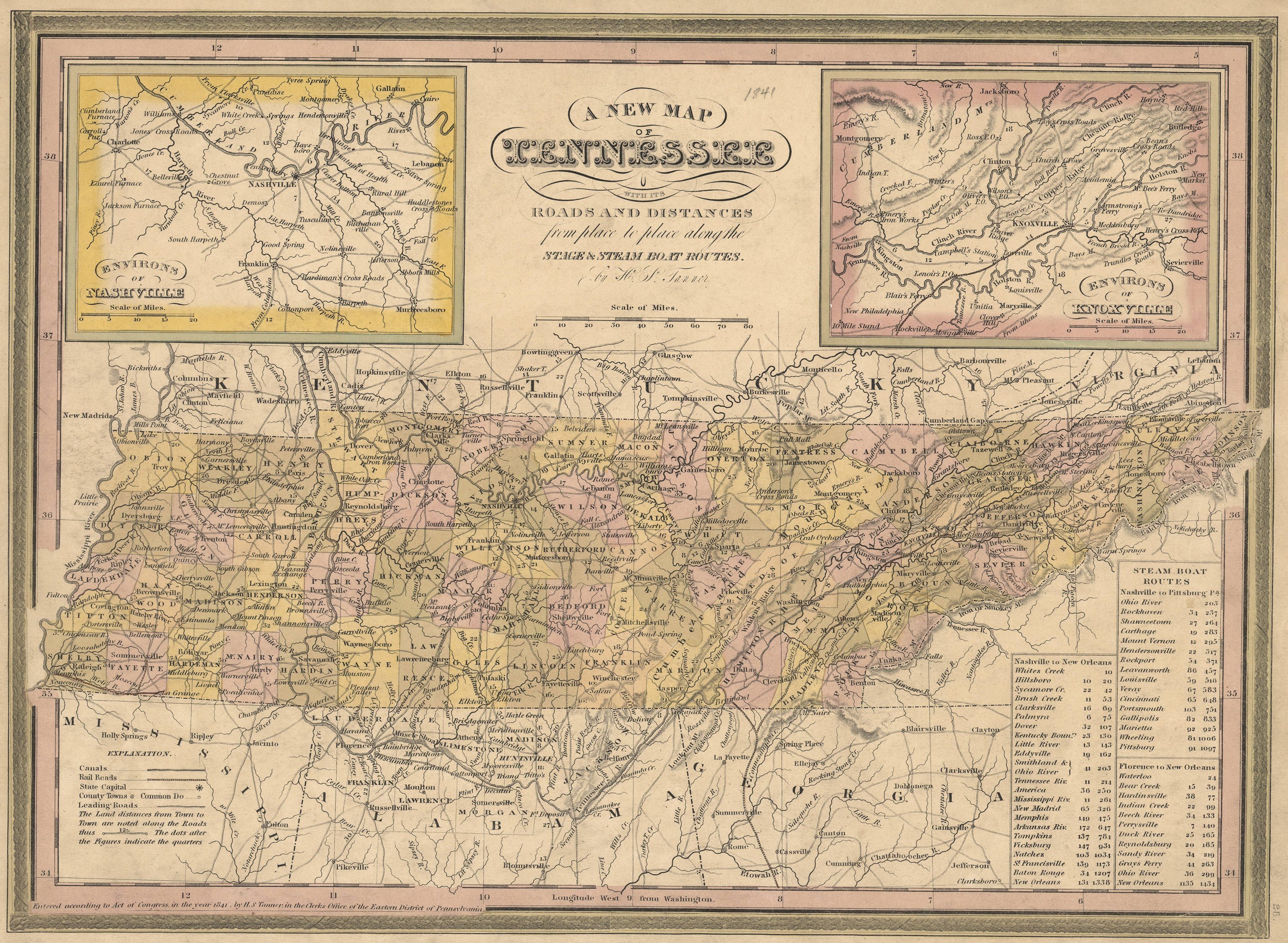
After the conclusion of the Civil War, the state of Tennessee was forced to confront diverse economic issues, bringing extensive difficulties and revealing critical differences amongst its geographic regions. Divided by statutes, rivers, valleys, and mountain ranges into the distinct “Three Grand Divisions,” the state walked separate economic paths during the Postbellum Era. West Tennessee, built upon fertile plains, was where large plantations required the labor of enslaved individuals for cotton production. Middle Tennessee, centered upon the soils of the Central Basin (and home to the state’s capital of Nashville), balanced an agricultural economy of livestock, grains, and tobacco. East Tennessee, which was distinct from both, was characterized by small family-owned farms across the Appalachian valleys that engaged in subsistence farming rather than speculative commodities. Following the close of the war, each section faced the task of rebuilding, yet their approaches interestingly varied. Whereas West Tennessee descended into unstable tenant farming, Middle Tennessee struggled with labor transitions in its commercial farm districts. East Tennessee, on the other hand, faced material poverty through independent landownership, isolation, and local river trade. By reviewing agricultural records, this brief reflection demonstrates how various regional approaches to labor and stewardship guided the Volunteer State’s economic through recovery following Civil War.
Methodology and Utilized Sources
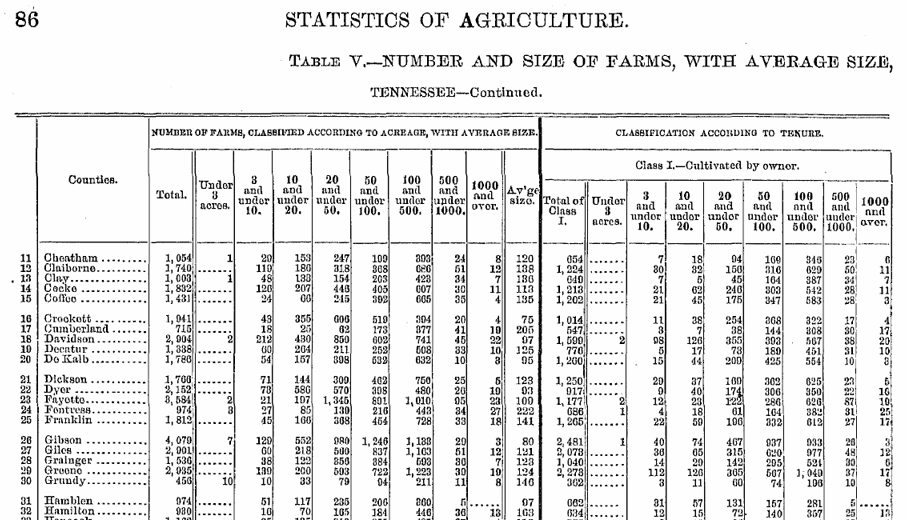
Comparing economic circumstances across these regions requires examining both federal documents and period surveys. This study draws upon primary statistics as well as secondary scholarship to evaluate how each “Grand Division” confronted these issues. The foundation for this study is based on the Tenth Decennial Census of the United States, appropriately placed at the center of the era, which was recorded in the Report on the Productions of Agriculture as Returned at the Tenth Census (June 1, 1880). These returns provide data such as farm acreage, property values, livestock numbers, and tenure arrangements. The tables record the proportion of farms cultivated directly by their owners in contrast to tracts worked under sharecropping agreements or cash rentals.
To understand the social aspects behind these numbers, this study examines J. B. Killebrew and J. M. Safford’s 1874 survey, Introduction to the Resources of Tennessee, which describes details such as soil conditions, credit shortages, and transportation across every county. This information was then also paired with two key historiographical studies: Robert Tracy McKenzie’s “Freedmen and the Soil in the Upper South: The Reorganization of Tennessee Agriculture, 1865–1880” and Donald L. Winters’s “Postbellum Reorganization of Southern Agriculture: The Economics of Sharecropping in Tennessee.” For summary, McKenzie uses census records across nine sample counties to track farm size, labor mobility, and property acquisition across the three Grand Divisions. Winters, in comparison, analyzes plantation contracts and legal rulings to explain how sharecropping operated as a financial compromise rather than a purely coercive endeavor. Together, these sources provide a respectable foundation for measuring the regional economies.
Postbellum Analytical Comparisons of the “Three Grand Divisions”
The economic diversity among the Divisions shows most apparent in how land was owned, cultivated, and financed. In West Tennessee, for instance, the end of slavery also meant the elimination of the sole fixed asset that planters had relied upon to secure credit. Retaining vast acreage while lacking the cash for daily wages, landowners in counties like Fayette, Haywood, and Shelby adapted by dividing their estates into small plots worked by sharecroppers. As Winters noted, while the Tennessee State Supreme Court ruled that sharecroppers were technically co-owners of the harvest, this legal protection prompted landlords to ensure the security of their profits through restrictive crop charges. As contemporary observer J. B. Killebrew also noted, planters faced constant credit panics and depreciating cotton values, patterns that discouraged long-term saving and ensnared laborers into cycles of debt. Yet, as McKenzie’s research revealed in relation, this transition away from centralized labor remained unfinished, with much of the region’s landless African American workers still toiling as wage hands rather than tenants.
Middle Tennessee, it could be argued, occupied a sort of ironic middle ground both economically and geographically. With access to banks and markets such as those in Nashville, counties like Maury and Robertson avoided cash-crop dependency by instead investing in quality livestock, wheat, corn, and tobacco. Yet, because antebellum farming across the area had previously relied upon enslaved labor, similar to West Tennessee, landowners faced considerable reorganization of their workforce. As Winters referenced regarding the records of planter George A. Washington, landlords adjusted to cash shortages by executing share contracts while maintaining considerable oversight of daily field operations. The 1880 census documented notably higher tenancy rates in Middle Tennessee than in the eastern counties, which may shock some while leaving other unsurprised, particularly in its commercial tobacco region. McKenzie echoed this finding, noting that Middle Tennessee experienced elevated rates of tenancy and wage labor compared to the smallholding mountain and valley communities to the east. Although Middle Tennessee farmers enjoyed more plentiful resources and stronger financial institutions than their Eastern and Western neighbors, their continual dependency on cash crops left them vulnerable to unstable labor arrangements and market speculation.
As for East Tennessee, this region of the state confronted trials of entirely different characteristics. Defined not by the collapse of the plantation, but by persistent poverty and geographical isolation, the region held a comparatively small antebellum slave population, implying that it was largely spared from the labor disruptions which upended its Middle and Western counterparts. As the 1880 federal census returns show for counties like Meigs, Roane, and Knox, agriculture persisted overwhelmingly as owner-operated, with landholding rates consistently settling near seventy to eighty percent. Rather than breaking apart into tracts, these small valley and hillside farms were worked directly by families who raised subsistence grains and livestock such as indian corn, winter wheat, oats, and hogs. McKenzie mentioned that although land was notably cheaper in East Tennessee (averaging less than five dollars per acre compared to nearly eight dollars in Middle Tennessee), these small farms often operated outside broader economies and thus garnered little capital. Yet, their lack of dependence on a specific cash crop indirectly gave an added layer of support that market-dependent cotton and tobacco planters wholeheartedly lacked. Killebrew’s study observed that while these households were typically poor, they sustained themselves through domestic consumption, diversified jobs, and the proverbial “shopping local.” Additionally, while railroads tracks cut their way through the valleys, rugged ridges often left rural areas cut off from rail access. In these isolated communities, farmers depended upon steamboat landings and flatboats, specifically along the Upper Tennessee River, as their primary opening to broader markets, transporting timber, crops, and livestock down to larger towns such as Knoxville and Chattanooga. While the rest of the state gambled upon cash crops and tenant farming, East Tennessee approached postbellum poverty through a different lens, operating in quiet resilience of small farms, local production, and river trade.
Conclusion
In conclusion, Tennessee’s postbellum economy shows that postwar recovery was neither uniform nor confined to a single narrative. Although West Tennessee planters and freedmen attempted to navigate the collapse of the plantation system, unstable markets and severe credit charges often burdened both with large sums of debt. In Middle Tennessee, many landowners leveraged Nashville’s banking channels to diversify production into livestock and tobacco, though high rates of tenancy and depleting crop values exposed the region to constant financial pains. In East Tennessee, residents endured both the era and widespread poverty through maintaining a self-sufficient, local system. Ultimately, it can be argued that the economic destiny of each Grand Division was largely determined by its pre-war labor force as well as environmental realities. Although speculative agricultural ventures often brought debt and caused instability, family stewardship on independent soil proved that quiet resilience was also needed in order to endure the era’s hardship.
Sources:
Killebrew, J. B., and J. M. Safford. Introduction to the Resources of Tennessee. Prepared under the Direction of the Bureau of Agriculture. Nashville: Tavel, Eastman & Howell, 1874.
McKenzie, Robert Tracy. “Freedmen and the Soil in the Upper South: The Reorganization of Tennessee Agriculture, 1865–1880.” The Journal of Southern History 59, no. 1 (1993): 63–84.
United States Census Office. Report on the Productions of Agriculture as Returned at the Tenth Census (June 1, 1880). Washington, D.C.: Government Printing Office, 1883.
Winters, Donald L. “Postbellum Reorganization of Southern Agriculture: The Economics of Sharecropping in Tennessee.” Agricultural History 62, no. 4 (1988): 1–19.


Leave a Reply